


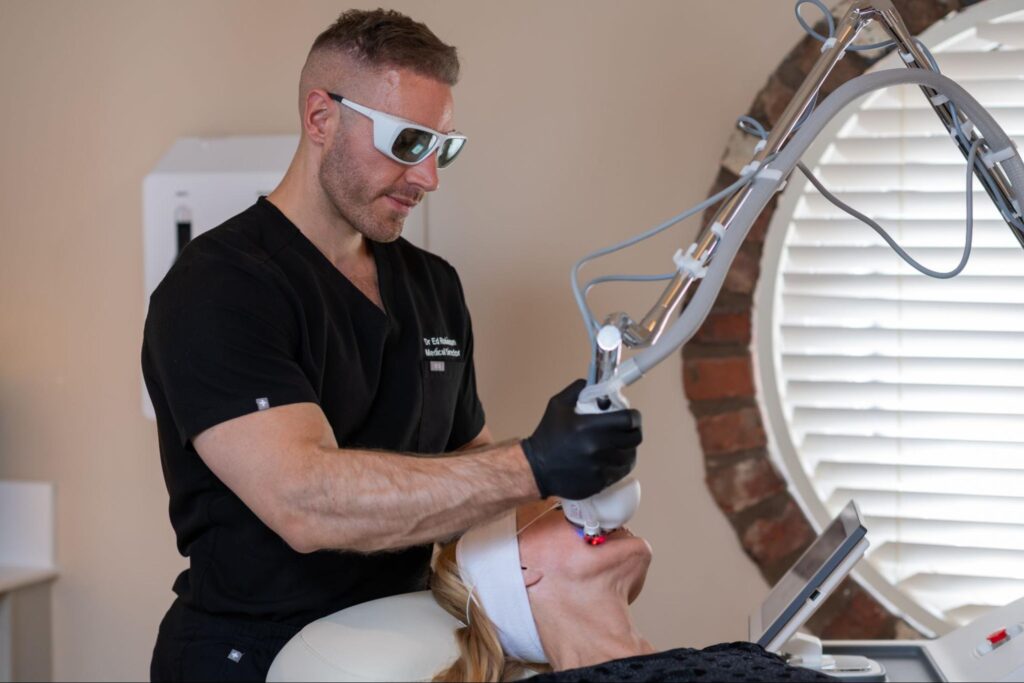
Facial ageing rarely affects just one part of the face. You might notice that your skin looks duller, fine lines are becoming more visible, or your cheeks have lost some of their previous fullness. Often, several changes are happening at once, which is why treating one concern in isolation does not always produce the result you are hoping for.
At Dr Ed Robinson Clinics, we take a holistic approach to facial rejuvenation, looking at skin quality, facial structure, volume and movement before recommending treatment. Advanced laser technologies and injectable treatments can both play an important role, but they work in different ways.
For some patients, laser treatment alone may be enough. Others may benefit from injectables, while a carefully planned combination can address different signs of ageing within the same treatment plan.
Why Does Facial Ageing Affect Everyone Differently?
As we age, collagen and elastin production gradually declines, contributing to fine lines, reduced firmness and changes in skin texture. Years of sun exposure may also lead to pigmentation, redness and uneven skin tone.
Beneath the skin, changes in facial fat, bone structure and soft tissue support can make the cheeks appear flatter, deepen facial folds or alter jawline definition.
These changes do not happen at the same rate for everyone. Someone may have relatively good facial volume but noticeable sun damage, while another person may have clear skin but more pronounced volume loss.
Understanding what is contributing to these changes helps us identify which treatments may be most appropriate.
What Can Laser Treatments Improve?
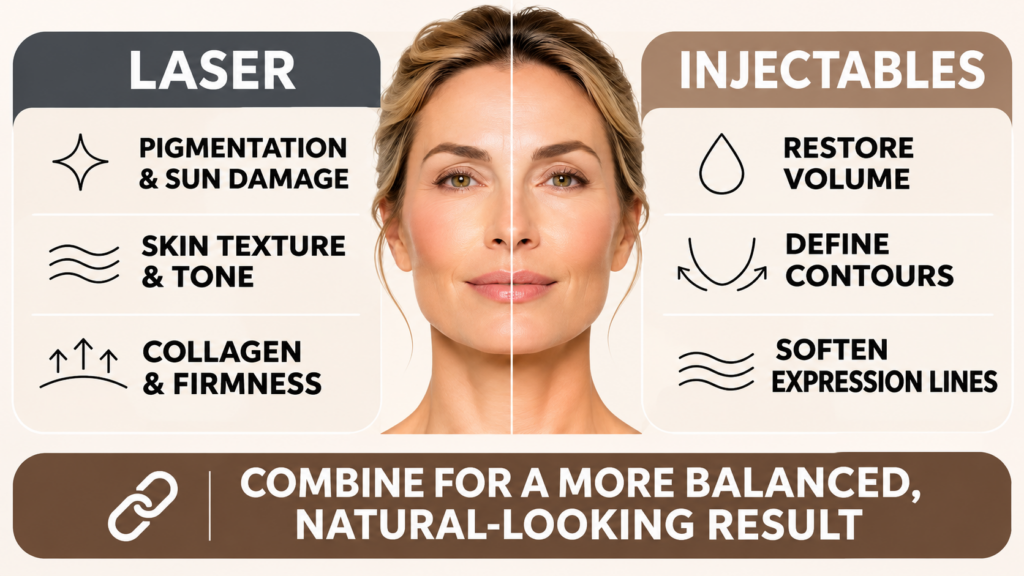
Laser and light-based treatments primarily address skin quality, although certain technologies can also stimulate collagen remodelling and improve mild skin laxity.
At Dr Ed Robinson Clinics, we use several advanced technologies for different skin concerns:
- BBL® HEROic™: Broadband light technology that can address suitable sun damage, pigmentation, age spots and superficial redness.
- MOXI®: A non-ablative fractional laser used to improve uneven texture, early sun damage and overall skin quality.
- HALO® TRIBRID™: A three-wavelength fractional laser combining ablative and non-ablative technologies to address fine lines, uneven texture and sun damage.
- ClearSilk®: A gentle laser treatment that may be considered for suitable redness concerns and general skin rejuvenation.
- Deep Erbium Laser Resurfacing: A more intensive resurfacing treatment for deeper lines, severe sun damage and more established textural changes. It can deliver significant skin renewal but involves substantial downtime and recovery.
Each technology works differently, so treatment selection depends on your skin type, concerns and tolerance for downtime.
Although laser treatment can improve skin clarity, texture and firmness, it cannot directly replace volume lost from the cheeks or other areas of the face.
What Can Injectable Treatments Improve?
Injectable treatments address changes that laser procedures may not adequately correct, particularly facial volume loss, structural support and expression-related lines.
For example, dermal fillers may restore volume in selected areas or improve facial contours. Anti-wrinkle injections can soften suitable expression lines by temporarily reducing activity in specific facial muscles.
The important consideration is identifying why a line, fold or hollow has developed. A deeper fold associated with volume loss may require a different approach from fine lines caused by sun damage or reduced skin elasticity.
Injectables cannot correct widespread pigmentation or rough skin texture, just as laser treatment cannot restore lost facial volume. This is why the two approaches may complement one another.
Laser vs Injectables: Why Might Combining Both Work Better?
At Dr Ed Robinson Clinics, we often approach skin rejuvenation by considering how to support the skin from both the inside out and the outside in.
Think of healthy skin as an ecosystem that needs nurturing at different levels. Injectable treatments can support certain changes beneath the skin, while laser and other energy-based technologies work on skin quality, texture and collagen remodelling.
For example, someone with sun damage and reduced cheek volume may benefit from laser treatment to improve skin quality alongside carefully placed dermal filler to address volume loss.
The aim is not to combine treatments simply for the sake of doing more. Each procedure should have a specific purpose, complement the others and be selected according to your facial anatomy, skin condition and expectations.
When Might Combining Laser and Injectables Be Beneficial?
There are several situations where we may consider both approaches within a longer-term facial rejuvenation plan.
1. Sun Damage and Facial Volume Loss
A patient may have pigmentation across the cheeks alongside reduced fullness through the midface. BBL HEROic may be considered for suitable pigmentation, while dermal fillers could address selected areas of volume loss.
The aim is to improve skin clarity and facial balance while preserving natural facial proportions.
2. Fine Lines and Uneven Skin Texture
Anti-wrinkle injections may help soften expression lines, while MOXI or HALO TRIBRID could improve associated textural changes. For deeper lines and more severe sun damage, deep Erbium resurfacing may be considered where a longer recovery period is acceptable.
3. Early Skin Laxity and Facial Contour Changes
Mild skin laxity may respond to treatments that stimulate collagen remodelling. However, where facial contour changes are partly related to volume loss, skin-focused treatment alone may not be sufficient.
Carefully selected injectable treatment may complement laser rejuvenation in suitable patients. More significant sagging may require a different approach, as injectables should not be used simply to compensate for substantial tissue descent.
Why Does Treatment Sequencing Matter?
Combining laser and injectable treatments requires planning because the order and spacing can affect recovery and treatment outcomes.
Certain laser procedures involve heat and a controlled healing response, while dermal fillers need time to settle. Performing treatments too close together may increase swelling or make it difficult to assess the results of each procedure.
In some cases, we may recommend improving skin quality first, then reassessing whether injectable treatment is needed. The appropriate sequence depends on the technology, treatment area, previous procedures and individual recovery.
Why Is Facial Anatomy So Important?
Facial rejuvenation involves more than identifying individual wrinkles or areas of pigmentation. Understanding facial anatomy helps us assess how changes in skin, fat distribution, tissue support and muscle movement affect the face as a whole.
Dr Ed’s background in anatomy and aesthetic medicine informs how he assesses facial proportions and plans treatment. His experience with advanced laser technologies and injectables allows him to consider which approach is most appropriate for each concern.
When addressing skin quality, Dr Ed may recommend an injectable treatment to support the skin from the inside out, followed by an appropriate laser treatment to improve the skin from the outside in. However, this is not a fixed sequence, and the order depends on the treatments involved, your anatomy and how your skin responds.
Frequently Asked Questions
Can I Have Laser Treatment If I’ve Already Had Dermal Fillers?
Yes, previous dermal filler treatment does not automatically prevent laser treatment. However, the filler type, injection site and time since treatment may influence which laser procedures are appropriate.
Always tell your practitioner about previous injectables so treatment can be planned safely.
How Long Should I Wait Between Laser and Injectable Treatments?
There is no universal waiting period, as different laser technologies require different recovery times. The appropriate interval also depends on the injectable treatment and whether both procedures involve the same area.
Dr Ed will advise on suitable treatment spacing following an assessment.
Will Laser Treatment Make My Dermal Fillers Dissolve Faster?
Not necessarily. Whether a laser affects existing filler depends on factors including treatment depth, energy settings and filler location.
Some energy-based treatments may affect filler longevity, although evidence varies between technologies. Previous filler treatments should therefore be discussed during your consultation.
At What Age Should I Consider Laser or Injectable Treatments?
There is no specific age at which facial rejuvenation becomes necessary. Some people develop sun damage or textural changes relatively early, while others experience more noticeable facial volume changes later.
Treatment decisions should reflect your individual concerns and facial anatomy rather than your age alone.
Can Laser Treatments Replace a Facelift?
Laser treatments can improve skin texture, fine lines and certain degrees of mild skin laxity. However, they cannot reproduce the lifting and repositioning of deeper facial tissues achieved through surgery.
Where sagging is more advanced, a surgical assessment may be more appropriate than additional non-surgical treatment.
A More Personalised Approach to Facial Rejuvenation
The most appropriate facial rejuvenation plan is not necessarily the one involving the most treatments. It is about understanding which changes are affecting your appearance and selecting treatments that address them without unnecessary intervention.
At Dr Ed Robinson Clinics, every treatment plan begins with a detailed consultation. We assess your skin quality, facial anatomy, medical history and expectations before discussing suitable options, likely outcomes and potential risks.
If you are considering facial rejuvenation, you can book a consultation at our Hale clinic in Cheshire, where laser and injectable treatments are available. Dr Ed also offers injectable consultations and treatments at our Harley Street clinic in London.