


Regenerative aesthetics has become one of the most talked-about areas of aesthetic medicine. Polynucleotides, PRP, PRF and collagen-stimulating injectables are increasingly discussed as options for people who want to improve the quality and condition of their skin, rather than simply add volume or temporarily change a particular feature.
But the word “regenerative” can be confusing. It covers a range of treatments that work in different ways, which means choosing between them requires more than simply deciding that you want a regenerative treatment.
At Dr Ed Robinson Aesthetics, we look first at what has actually changed. Is the skin becoming thinner or less resilient? Has collagen declined? Is there genuine facial volume loss? Is laxity becoming more noticeable? Often, several changes are happening at the same time.
This distinction matters because stimulating the skin cannot always replace lost volume, just as adding volume will not necessarily improve the quality of the skin itself.
What Does Regenerative Aesthetics Mean?
Regenerative aesthetics refers to treatments designed to encourage the body’s own biological processes, with the aim of improving the quality, strength or condition of the skin and tissues over time.
Our skin is constantly renewing and repairing itself. Collagen and elastin help provide strength, structure and elasticity, while cells within the skin contribute to maintaining and repairing the tissue. As we age, these processes gradually become less efficient. Collagen levels decline, skin can become thinner and less elastic, and its ability to retain moisture can change.
Different regenerative treatments target these changes in different ways. Some encourage collagen production, while others support tissue repair, hydration or overall skin quality.
This is why regenerative aesthetics is an umbrella term rather than one specific type of treatment. Polynucleotides do not work in exactly the same way as PRP, and neither works in the same way as Radiesse®. Understanding those differences is important when deciding which approach is most appropriate for a particular skin concern.
Which Treatments Are Considered Regenerative?
Several treatments available at Dr Ed Robinson Aesthetics focus on improving the skin and tissues rather than simply creating facial volume.
Polynucleotides
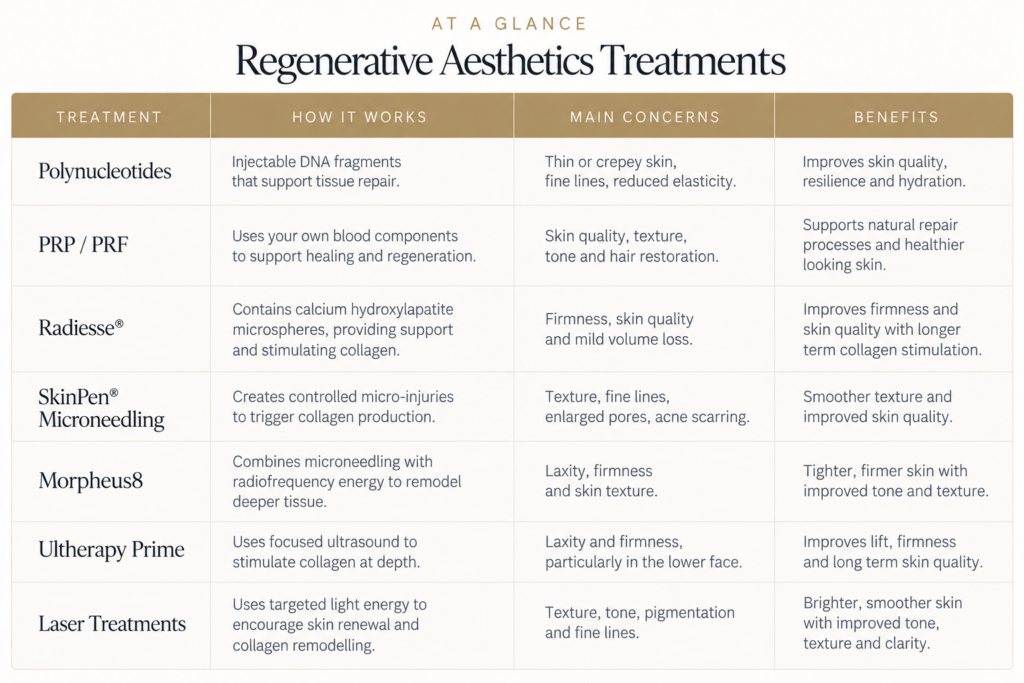
Polynucleotides are injectable treatments made from purified DNA fragments. They are used to support tissue repair and improve the condition and resilience of the skin.
Rather than filling a hollow or changing facial contours, the aim is gradual improvement in the quality of the tissue.
They can be particularly useful for:
- thin or crepey skin
- reduced elasticity
- fine lines
- tired-looking skin
- declining skin quality around delicate areas such as the eyes
This makes polynucleotides particularly relevant for people who want to improve skin quality without necessarily adding facial volume.
The changes develop gradually, and treatment is usually planned as a course rather than expecting a significant change from a single session.
PRP and PRF
Platelet-rich plasma and platelet-rich fibrin use components taken from the patient’s own blood.
A small blood sample is collected and processed to concentrate platelets and other useful components. Platelets contain growth factors and signalling proteins that are naturally involved in healing and tissue repair.
PRP and PRF therefore work very differently from conventional filler. Instead of placing a volumising gel into the face, the treatment uses material obtained from your own body to support regenerative processes within the tissue.
At the clinic, PRP is also used alongside polynucleotides within regenerative hair restoration programmes, showing how regenerative approaches can be used beyond facial rejuvenation.
Radiesse®
Radiesse is slightly different because it can provide structural support while also stimulating collagen.
It contains calcium hydroxylapatite microspheres, which can provide an initial supportive effect while encouraging collagen production over the following weeks and months.
Radiesse can also be diluted when the aim is less about creating volume and more about improving skin firmness and quality.
This can make it useful where the concern goes beyond dehydration or very early skin changes, but traditional volume replacement is not necessarily the main priority. How Radiesse is prepared and placed will depend on the tissue, treatment area and intended result.
Are Microneedling and Energy-Based Treatments Regenerative Too?
The definition becomes broader when we look beyond injectables.
SkinPen® Microneedling creates tiny, controlled micro-injuries in the skin. These trigger a natural healing response that includes collagen remodelling. Rather than adding volume, the treatment gives the skin a controlled stimulus to repair and renew itself.
Some energy-based treatments work on a similar principle, although they use different forms of energy and target different depths.
Morpheus8 combines microneedling with radiofrequency energy to encourage tissue remodelling, while Ultherapy Prime uses focused ultrasound to stimulate collagen at deeper levels.
Laser treatments can also encourage controlled renewal and collagen remodelling. These treatments are not interchangeable with regenerative injectables, but they highlight an important point. Different concerns require different types of stimulation at different depths.
Is Regenerative Aesthetics Better for Natural-Looking Results?
Regenerative treatments can be particularly useful for people who want to improve the quality, firmness or resilience of their skin without significantly changing their facial proportions.
The changes also tend to develop progressively because collagen production and tissue remodelling take time. However, natural-looking results do not mean using regenerative treatments alone.
Someone may have good skin quality but noticeable volume loss through the temples or mid-face. Another person may have retained their facial volume but developed thin, crepey skin around the eyes. Others may have a combination of volume loss, laxity, pigmentation and changes in skin quality.
These concerns cannot all be addressed with the same treatment. A natural result is more likely to come from identifying what is actually causing the visible change and choosing treatment accordingly.
Can Regenerative Treatments Be Combined?
Yes. In some cases, combining or carefully sequencing treatments allows us to address different aspects of the skin and face.
For example, SkinPen microneedling may be used to encourage skin remodelling, while polynucleotides may be considered when tissue quality and resilience are a particular concern. PRP and polynucleotides can also be used together within regenerative hair restoration programmes.
Where facial ageing is more established, we may need to consider deeper support as well as skin quality. Radiesse may be appropriate when collagen stimulation and structural improvement are needed, while Ultherapy Prime or Morpheus8 may be considered where laxity and deeper tissue remodelling are the priority.
Dermal filler can still have an important role when genuine facial volume has been lost.
The aim is not to combine treatments for the sake of doing more. Skin condition, treatment depth, recovery, timing and the patient’s priorities all influence whether treatments are best combined, staged or used individually.
In practice, a progressive approach often makes the most sense. It allows us to see how the skin responds before deciding whether another treatment would add something useful.
How Do You Know Which Regenerative Treatment Is Right for You?
The most useful place to start is with the concern rather than the treatment name.
When someone feels that their face suddenly looks older or more tired, there may be several reasons. The skin may have become thinner or less hydrated, collagen may have declined, facial volume may have changed or early laxity may be developing. Often, more than one factor is involved.
For milder changes in skin quality, treatments such as Profhilo, Sunekos, polynucleotides or microneedling may be considered, depending on what we see during assessment.
Where there is greater collagen loss or reduced structural support, a biostimulator such as Radiesse may be more appropriate. More noticeable laxity may require a different approach, potentially using Ultherapy Prime or Morpheus8.
If the main concern is genuine facial volume loss, dermal filler may still be the most appropriate treatment for that particular issue.
This is perhaps the most useful way to think about regenerative aesthetics. Rather than asking, “Which regenerative treatment should I have?”, start by asking what has changed in my skin or face, and what type of treatment is most suited to that change?
FAQs About Regenerative Aesthetics
What age should I start regenerative aesthetic treatments?
There is no set age. Skin quality, genetics, sun exposure, lifestyle and individual ageing patterns are more useful considerations than age alone. Treatment should be based on what your skin needs rather than reaching a particular birthday.
Can regenerative aesthetics be used on the neck and hands?
Yes. Depending on the treatment, regenerative and collagen-stimulating approaches can be used beyond the face. The neck, décolletage and hands can all develop thinning, crepiness and reduced elasticity, so these areas may also benefit from appropriately selected treatments.
Can men have regenerative aesthetic treatments?
Yes. Men experience changes in collagen, skin quality and tissue structure too. Treatment can be adapted to the individual’s skin, anatomy and concerns without necessarily changing facial shape or proportions.
Do I still need skincare if I have regenerative treatments?
Yes. In-clinic treatments and daily skincare have different roles. Appropriate skincare and consistent sun protection remain important for supporting skin health and maintaining results.
Can regenerative aesthetics stop skin ageing?
No treatment can stop the natural ageing process. Regenerative aesthetics is better thought of as a way of supporting skin quality, collagen and tissue condition as they change over time. The aim is healthy, resilient skin rather than trying to stop ageing altogether.
Considering Regenerative Aesthetics in Cheshire?
If you are interested in regenerative aesthetics but are unsure which approach may suit your skin, a consultation can help establish what is behind the changes you have noticed.
At Dr Ed Robinson Aesthetics in Hale, Cheshire, we assess factors such as skin quality, facial structure, volume and laxity before discussing whether a single treatment, a staged combination or simply ongoing skin care would be most appropriate.
Book a consultation to discuss your skin and the different options available.